A boots on the ground perspective on the Chile riots

August 29, 2011
Santiago, Chile

You’ve probably heard that old saying– ‘if you’re not a socialist by the time you’re 20, you have no heart. If you’re still one by the time you’re 30, you have no brain.’

This is true everywhere in the world. Even in capitalist bastions like Hong Kong, there is a misguided minority that believes they should prosper from others’ labor.

Usually this attitude fades with age and career progression, right around the time someone strokes his/her first check to the local tax authority. After all, it’s much easier to be a socialist when you’re on the receiving end of benefits, not the one footing the bill.

Here in Chile, my adopted home for many years, it’s no different. A market-oriented society with a thriving economy, Chile has had remarkable growth over the last 20-years. Its economic expansion has been no doubt due to this market-based model, as well as surging demand for copper, Chile’s prime export.

People in Chile recognize that their standard of living is much higher than it has ever been, especially compared to their neighbors who still dabble in socialism.

Just over the mountains, for example, Argentina is a hopeless basket case whose government makes a sport of fleecing its people and maintaining the elitist mafia-like plutocracy.

Now– the last few weeks in Chile have showcased student protests over the cost of their university education; they demanded that the government provide free tuition to all students, and they weren’t going to take NO for an answer.

At first, most of the country supported them. Local polls showed that Chileans were proud of their kids standing up to the government and letting their voices be heard… even if they didn’t agree with the politics.

You see, Chile is a pretty conservative place. There are definitely pockets of socialism throughout the country, as there are just about everywhere, but if Ron Paul were running for President here, he would do quite well… and certainly get all the media coverage he could handle.

For the most part, Chileans were just happy to see their kids get off Facebook for a few days and stand up for an issue that was important for them. After all, that’s what those impressionable university years are for.

Then Chile’s socialist CUT union came along to exploit the student protests and capitalize on the wave of turmoil around the world in order to advance their agenda.

CUT escalated the protests into violent riots. They attacked the police, they looted some shops, they destroyed some property, and they attempted (and failed) to shut down city traffic in Santiago.

All the while, the police kept a cool head. I’ve seen videos of G20 riots and austerity protests in the US, Greece, and Spain where the police mercilessly club and beat protestors into submission. That’s not how it works in Chile.
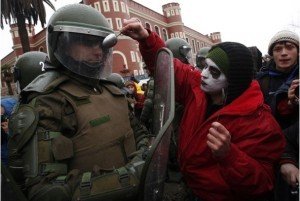
screen capture 3 300x201 A boots on the ground perspective on the Chile riots

Photo by: Roberto Candia/Associated Press. How fast would this guy get clubbed where you live?

In fact, the Washington Post ran an article criticizing the Chilean government for being too soft on the protestors, saying that the government “looked powerless to curtail the anger in the streets.”

Powerless? Because cops kept their cool? The photo in the Post’s article shows a student protestor physically taunting one of the policemen at the scene. How do you think this would have gone down in North America?

Frankly I’m happy to live in a place where the police refuse to squash people like bugs… where people are not afraid of their government like they are in North America and Europe.

Yes, one person died in the riots. Considering the tens of thousands of people who were in a confined space flinging rocks in every direction, though, this is pretty much a miracle.

Things here seemed to have calmed down now, giving everyone some time to reflect on the events that transpired. Here’s my takeaway given years on the ground, my local family, and my experience in Santiago as a university professor:

1) Of the 3.5 million students in Chile, only a small percentage of them were protesting.

2) The rioters do not reflect the attitude of the nation. Recent clippings from La Tercera summed up the event as “[a] work stoppage which found no public support” and “reprehensible opportunism that the public is unwilling to accept.”

3) While there will always be people everywhere who want something for nothing, Chileans are quite happy with their economic prospects. They have no desire to return to the hyperinflationary socialist experiments of the past.

4) When things turned violent, many of the student protestors actually turned on their fellow CUT rioters and tried to prevent them from looting and destroying property. Chilean media published these accounts. Foreign media did not.

5) I credit the police here for protecting private property and dealing with the violent rioters in a very professional way.

6) Despite foreign media accounts that it was a war zone down here, most of Santiago was business as usual. Throughout the events, I was never personally inconvenienced because of what was happening.

As Simon Black often says, no place is perfect, and neither is Chile. But I have never once regretted my decision to move here. Ultimately, Chile remains a free, respectful, market-oriented, opportunity-rich country on a long-term uptrend, and that hasn’t changed one bit.

Get Fresh Updates and Build Your Freedom
Join 117,239+ subscribers and get the Notes from the Field newsletter with actionable information on how to build your freedom. Enter your email below to get started:
arrow 3 A boots on the ground perspective on the Chile riots

Comments on this entry are closed.

  • Diogenese_

     Thanks for a great article Dr Cobin. The fact that the true story is that the large majority of the Chilean people rejected and shut down a socialist thug riot during a global depression is highly positive for the country. Also, the contrast you painted between market oriented Chile and the other peoples money oriented national neighbors is highly significant. Countries that embrace more of the free market are getting ahead, those that don’t are falling behind and into oblivion.

     I think the mafia description of Argentina is exactly where the US is already and going ever more. There was recent news that big US investment banks got over 1 trillion from the fed in 2008-2009 and that was not revealed until now.  What secret transfers involving a trillion or more dollars of ‘aid’ to private elites will the US do next time? At what cost will that be to the inflation hit none elite man and woman in the street?

    • MadDog

      I agree, Diogenese.  I don’t know if I’d call it all the “mafia”, but it’s becoming increasingly clear that the US suffers from some serious “organized-crime” problems.  It has deep roots in our government, central banks, wall street and labor unions; it’s increasingly in our media and sadly has corrupted our educational system.  It is impossible for free-market patriots to challenge any of these institutions; and the number of freeloading socialists has surpassed 50% and continues to grow.  Even the moderates that used to balance the scales are continually falling into the trap that Simon referred to as the “political idiots”.  Politics SHOULDN’T be a dirty word; legislation and taxation shouldn’t be forbidden conversation at parties; the discussion of human rights & liberties SHOULD be water-cooler subjects – not inane Hollywood gossip or billion-dollar pro-sport addicts.

      Dr. Cobin – save me a spot  :o)

  • jaf

    John
    My sense is that Pinera will cave to the protestors and institute (further?) subsidies to education. As a supposed conservative I am not sure he is a friend of the free market.

  • Anonymous

    but if Ron Paul were running for President here, he would do quite well… and certainly get all the media coverage he could handle.
    He does not get much media coverage here in the US

  • bill f

    I agree with your assessment of the Chilean population liking things as they are. I was living in Chile not even a year ago, and came away with the same conclusion. They’re pretty happy with the way things are, and won’t give in to socialism or another dictatorship.

  • bill f

    I agree with your assessment of the Chilean population liking things as they are. I was living in Chile not even a year ago, and came away with the same conclusion. They’re pretty happy with the way things are, and won’t give in to socialism or another dictatorship.

  • bill f

    I agree with your assessment of the Chilean population liking things as they are. I was living in Chile not even a year ago, and came away with the same conclusion. They’re pretty happy with the way things are, and won’t give in to socialism or another dictatorship.

  • bill f

    I agree with your assessment of the Chilean population liking things as they are. I was living in Chile not even a year ago, and came away with the same conclusion. They’re pretty happy with the way things are, and won’t give in to socialism or another dictatorship.

  • Anonymous

    As usual foreign (read: US) media didn’t cover what really happened. They ALWAYS spin the story to meet their agenda. Just like when they talked up Hurricane Irene. They made it sound like an End of Days thing. No doubt in an effort to pump up the economy. Maybe I should move to Chile. It’s definitely one of my prospects.

  • Occie1

    what do i have to do to move to Chile, besides getting married to a chillian.

  • MadDog

    I’m not sure what your point is?  If the Chilean universities charge 12 times that of the Swiss – AND its universities are still attended by tens of thousands of students – then their schools must be superior.  ???

    I believe in the free-market system.  I believe in running everything “as a for-profit business”.  Identify your market and then design your product (in this case – an educational offering) and charge a fee (tuition) commensurate with that product, its consumers, and its competition. 

    We live in an international world, and universities are no exception.  In fact – with the advent of the internet and online courses – universities of all countries will be challenged to compete in this international free-market model.  Universities that require huge subsidies from the local or even national government (tax payers) will be the losers.

    • chichichi

      MadDog,
      You can`t run everything as a “for profit business”; citizens at some point must be citizens and not strictly consumers.

      The ongoing protests in Chile demand education reform from primary school to the university. The Chilean state spends less per student than any other OECD country, including Mexico, and the education disparity between private and public schools, according to the same organization, is one of the worst worldwide.

      It`s clear reform is overdue here. The question is MadDog, as a free-marketeer, how would you provide a decent public education for children 5 to 18 years old?

    • chichichi

      MadDog,
      You can`t run everything as a “for profit business”; citizens at some point must be citizens and not strictly consumers.

      The ongoing protests in Chile demand education reform from primary school to the university. The Chilean state spends less per student than any other OECD country, including Mexico, and the education disparity between private and public schools, according to the same organization, is one of the worst worldwide.

      It`s clear reform is overdue here. The question is MadDog, as a free-marketeer, how would you provide a decent public education for children 5 to 18 years old?

  • Roterfunken

    You say: “5) I credit the police here for protecting private property and dealing with the violent rioters in a very professional way.” Have a look, sovereign man, what kind of police you are crediting: http://vimeo.com/28179683

  • Diogenese_

     You mean not paying anything other than fearing for your life while walking around Buenos Aires because of all the crime and lack of jobs caused by government spending destruction of the economy?

Next Post:

Previous Post:

Read more:
iStock_000017466099XSmall
This is what’s driving the startup bubble

Close